 Add to Chrome
 Add to Firefox
 Add to Edge
Unified Value Alignment for Generative Recommendation in Industrial Advertising
May 07, 2026
Generative Recommendation (GR) reformulates recommendation as a next-token generation problem and has shown promise in industrial applications. However, extending GR to industrial advertising is non-trivial because the system must optimize not only user interest but also commercial value. Existing GR pipelines remain largely semantics-centric, making it difficult to align value signals across tokenization, decoding, and online serving. To address this issue, we propose UniVA, a Unified Value Alignment framework for advertising recommendation. We first introduce a Commercial SID tokenizer that injects value-related attributes into SID construction, yielding value-discriminative item representations. We then develop a Generation-as-Ranking SID Decoder jointly optimized by supervised learning and eCPM-aware reinforcement learning, which fuses value scores into next-item SID generation to perform generation and ranking in one decoding process. Finally, we design a value-guided personalized beam search that reuses generation-as-ranking logits as online value guidance and applies a personalized trie tree to constrain decoding to request-valid SID paths. Experiments on the Tencent WeChat Channels advertising platform show that UniVA achieves a 37.04\% improvement in offline Hit Rate@100 over the baseline and a 1.5\% GMV lift in online A/B tests.

GPR: Towards a Generative Pre-trained One-Model Paradigm for Large-Scale Advertising Recommendation
Nov 13, 2025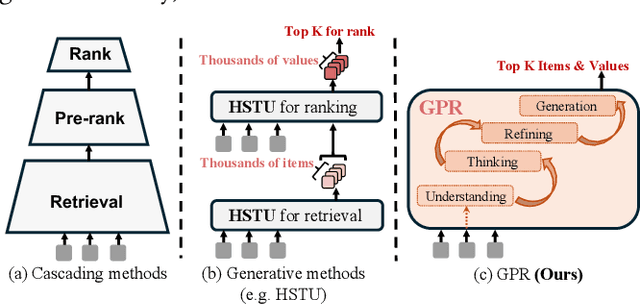
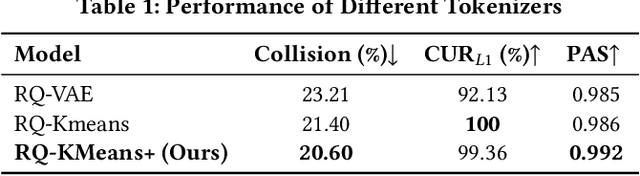
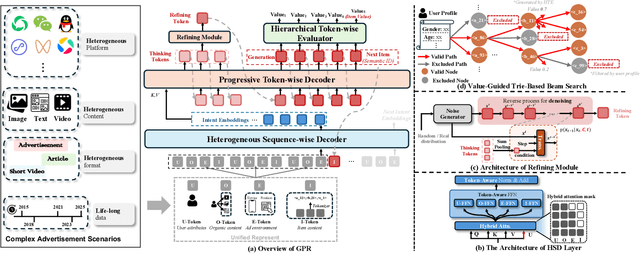
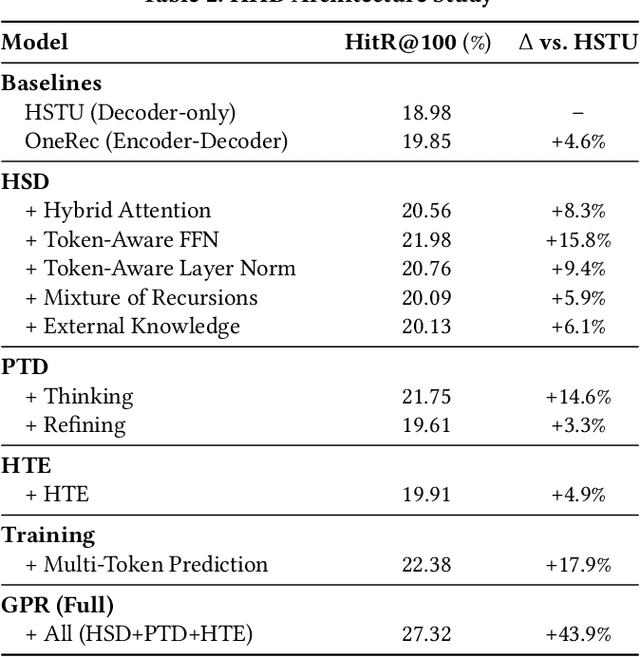
As an intelligent infrastructure connecting users with commercial content, advertising recommendation systems play a central role in information flow and value creation within the digital economy. However, existing multi-stage advertising recommendation systems suffer from objective misalignment and error propagation, making it difficult to achieve global optimality, while unified generative recommendation models still struggle to meet the demands of practical industrial applications. To address these issues, we propose GPR (Generative Pre-trained Recommender), the first one-model framework that redefines advertising recommendation as an end-to-end generative task, replacing the traditional cascading paradigm with a unified generative approach. To realize GPR, we introduce three key innovations spanning unified representation, network architecture, and training strategy. First, we design a unified input schema and tokenization method tailored to advertising scenarios, mapping both ads and organic content into a shared multi-level semantic ID space, thereby enhancing semantic alignment and modeling consistency across heterogeneous data. Second, we develop the Heterogeneous Hierarchical Decoder (HHD), a dual-decoder architecture that decouples user intent modeling from ad generation, achieving a balance between training efficiency and inference flexibility while maintaining strong modeling capacity. Finally, we propose a multi-stage joint training strategy that integrates Multi-Token Prediction (MTP), Value-Aware Fine-Tuning and the Hierarchy Enhanced Policy Optimization (HEPO) algorithm, forming a complete generative recommendation pipeline that unifies interest modeling, value alignment, and policy optimization. GPR has been fully deployed in the Tencent Weixin Channels advertising system, delivering significant improvements in key business metrics including GMV and CTCVR.